
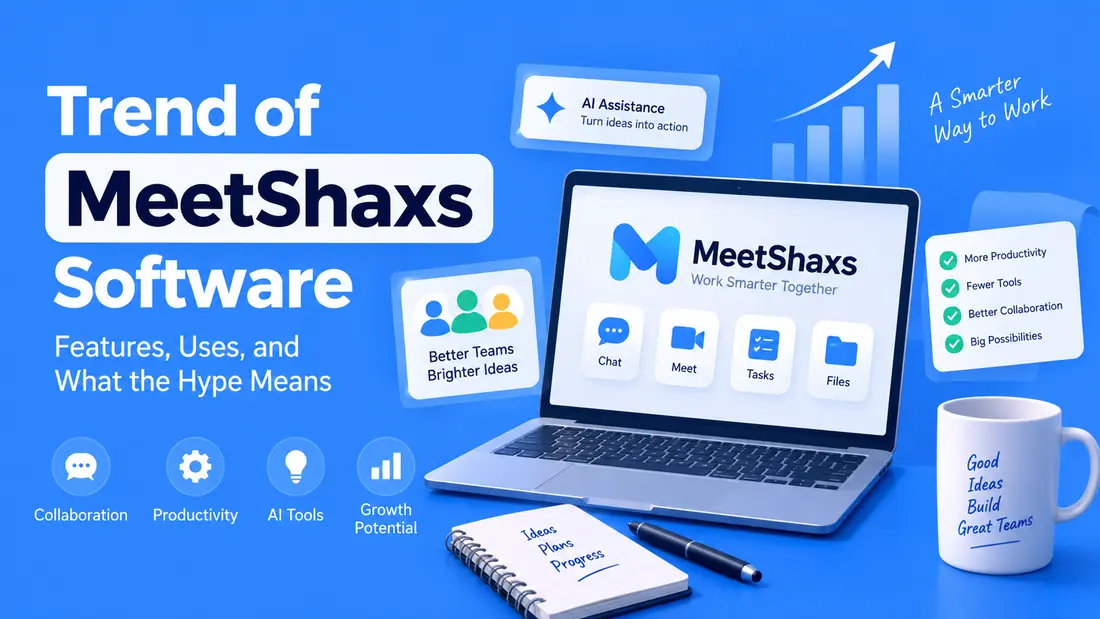
MeetShaxs software is getting attention in online discussions, but there is a catch. The name does not yet point to one clearly documented product with a confirmed user base, public growth figures, and a consistent list of features.
Instead, different articles describe MeetShaxs in different ways. Some connect it with team collaboration and AI productivity. Others describe product naming tools, while a few mention software optimization and diagnostics.
That makes the trend of MeetShaxs software an interesting topic, but also one that needs a closer look. Is this a rising software product, a growing search topic, or a mix of several ideas?
Let’s break down what the available information says, what remains unclear, and why people are searching for it.
What Is MeetShaxs Software?
MeetShaxs is an online software name associated with several overlapping descriptions. Based on the available articles, it is not yet possible to confirm that every reported feature belongs to one single, established platform.
The name is commonly linked to three main software concepts.
MeetShaxs as a Collaboration and Productivity Tool
Some sources describe MeetShaxs as a platform for bringing everyday team tasks into one place.
Reported features include:
- Team messaging
- Online meetings
- Task management
- File sharing
- Workflow automation
- AI-assisted productivity
The idea is familiar. Instead of moving between several apps to chat, manage tasks, share files, and follow up after meetings, a team could use one workspace.
That is a useful concept for remote teams, small businesses, and companies trying to reduce the number of tools they use each day. However, these descriptions should be treated as reported features until they can be confirmed through direct product documentation.
MeetShaxs as a Product-Naming Tool
Another set of descriptions connects MeetShaxs with product naming and branding decisions.
These reports mention features such as:
- AI-generated name ideas
- Domain availability checks
- Social handle checks
- Preliminary trademark searches
- Anonymous voting
- Linguistic analysis
- Naming decision records
Imagine a startup team trying to name a new app. One person likes a short name, another wants something more memorable, and someone else is already checking whether the domain is available. A tool that brings these steps together could make that process easier.
This is a different use case from team collaboration, which is why the varying descriptions matter.
MeetShaxs as a Software Optimization Platform
A few sources also associate the name with software diagnostics, performance improvement, debugging, and development-related tools.
These claims suggest a connection to software management rather than meetings or branding.
At this stage, the safest way to describe MeetShaxs is as an inconsistently documented software name with several reported uses. Readers should not assume that every feature mentioned online belongs to the same confirmed product.
What Does the Trend of MeetShaxs Software Actually Mean?
The phrase “trend of MeetShaxs software” can sound like it refers to a clear rise in users or market share. The available information does not establish that.
Instead, the trend appears to be more closely linked to online visibility, published articles, and search interest.
That distinction matters.
A software name can appear in many articles without having a large customer base. A topic can gain search traffic because people are curious about it, because publishers are writing about it, or because several articles use similar keywords.
None of those things, by themselves, prove widespread adoption.
Online Interest Is Not the Same as Product Adoption
There are several ways to measure software growth:
- Number of active users
- Revenue growth
- Customer retention
- Market share
- Downloads
- Enterprise contracts
- Independent customer reviews
The supplied research does not provide verified figures for these areas specifically for MeetShaxs.
So, while the name is receiving attention, it would be inaccurate to describe it as a proven mass-market software platform.
Why Is the Trend Difficult to Measure?
The main issue is that the available descriptions are not consistent.
One article may describe MeetShaxs as a collaboration platform. Another may focus on product naming. A third may connect it with software optimization.
When the product identity is unclear, it becomes difficult to answer basic questions such as:
- Who developed the software?
- What is its official website?
- What features are actually available?
- How many people use it?
- What does it cost?
- Which businesses use it?
- Is there an official product roadmap?
Without clear answers, claims about growth should be treated with care.
The Main Trend Narrative
The online discussion around MeetShaxs usually connects it with several wider software trends:
- AI-powered workflows
- Remote and hybrid collaboration
- All-in-one productivity tools
- Product naming and branding support
- Software security and data handling
These are real areas of interest in the software industry. But they explain the context around the discussion, not confirmed adoption figures for MeetShaxs itself.
Why Is MeetShaxs Software Trending Online?
Several factors may help explain why the name is appearing in more software-related searches and articles.
AI Is Changing How People Think About Software
AI has become a common part of productivity software. People now expect tools to do more than store information or provide basic communication features.
They want software that can:
- Summarize meetings
- Extract action items
- Suggest ideas
- Automate repeated tasks
- Help with research
- Support business decisions
MeetShaxs is often described using some of these AI-related ideas. That connection makes the name relevant to people already searching for AI productivity tools.
Still, it is worth separating the wider AI trend from confirmed MeetShaxs capabilities.
Businesses Want Fewer Separate Tools
Many teams use one app for messaging, another for meetings, another for project management, and another for file storage.
Over time, this can create what is often called tool sprawl.
Tool sprawl means a business has so many separate software tools that employees spend too much time switching between them, managing logins, and searching for information.
An all-in-one workspace sounds appealing because it promises a simpler setup.
Some articles place MeetShaxs within this broader idea of combining communication, tasks, files, and automation. Whether the software currently delivers all of those features is a separate question.
The Name Appears Across Different Content Types
MeetShaxs has been mentioned in publisher articles, LinkedIn posts, and niche software discussions.
When several pieces of content cover similar keywords, a software name can become more visible in search results.
For example, one article may answer “What is MeetShaxs software?” while another covers its advantages, and a third discusses its rising trend.
This creates a content cluster around the name. It can increase awareness, but it does not automatically prove that more people are using the product.
Unclear Product Identity Creates Curiosity
Confusion can also drive searches.
When readers see different descriptions of the same software name, they naturally want to know what is accurate.
Common questions include:
- Is MeetShaxs a real software product?
- What does MeetShaxs actually do?
- Is MeetShaxs a collaboration tool?
- Is MeetShaxs safe?
- Is MeetShaxs legitimate?
- Is MeetShaxs an alternative to Slack or Microsoft Teams?
These questions show why clarity matters. People are not only looking for features. They are also trying to understand what the name represents.
Reported Features and Possible Uses of MeetShaxs
The following table summarizes features mentioned in the supplied sources. These should be treated as reported descriptions, not confirmed specifications.
| Reported area | Possible use |
|---|---|
| Messaging and meetings | Team communication |
| Task management | Tracking work and deadlines |
| File sharing | Keeping project materials together |
| AI assistance | Meeting summaries, task extraction, or name ideas |
| Naming tools | Comparing and selecting product names |
| Voting features | Collecting team feedback |
| Diagnostics | Reviewing software performance |
The possible uses cover several different needs.
A remote team might be interested in communication and task management. A branding team might care more about name ideas and voting. A developer might look for diagnostics or performance tools.
That range is part of what makes the topic interesting, but it also makes product verification especially important.
MeetShaxs Software and the Rise of AI-Powered Collaboration
The interest around MeetShaxs fits into a wider shift in how businesses use software.
AI Meeting Support
Meeting software is no longer limited to video calls. Many modern tools are expected to help users capture notes, summarize discussions, and turn conversations into action items.
For a busy team, this can save time. Instead of asking, “What did we agree on yesterday?” someone can review a summary or task list.
Some descriptions of MeetShaxs connect it with these types of AI features. However, the exact capabilities still need confirmation.
Workflow Automation
Businesses often lose time on small repeated tasks.
Sending reminders, updating task lists, organizing information, and moving data between apps can all add up.
Workflow automation aims to reduce that repeated work. If MeetShaxs does offer the automation features described in some articles, that would place it within a familiar software category.
One Workspace Instead of Many Apps
The idea of one workspace is not new, but it remains attractive.
A team may prefer to keep conversations, files, tasks, and meeting notes together rather than spread across several platforms.
This is one reason all-in-one software continues to attract attention. The promise is simple: fewer app switches and a clearer view of work.
AI for Product Naming and Team Decisions
The reported naming-related features point to another growing use of AI.
A naming tool could help teams generate ideas, compare options, check basic availability, and collect feedback before choosing a name.
For example, a product team launching a new SaaS tool might use a naming workflow to compare ten possible names instead of relying on a long email thread.
That is a practical use case, but it should not be confused with proof that MeetShaxs has a confirmed, widely used naming platform.
MeetShaxs Software: Hype vs. Verified Information
One of the most important parts of this topic is knowing where the available information stops.
Here is a simple breakdown.
| Topic | What can be said |
|---|---|
| Online visibility | MeetShaxs appears in several software-related articles and posts |
| Product identity | Descriptions vary across sources |
| Reported features | Several features are mentioned, but direct product documentation is limited |
| User numbers | No verified public figures were supplied in the research |
| Market share | No verified market-share data was supplied |
| Pricing | Clear, consistent public pricing is not established |
| Security claims | Compliance claims need direct evidence |
| Adoption trend | Online interest is visible, but widespread adoption is not proven |
This distinction protects readers from confusing repeated claims with verified facts.
A feature mentioned in five articles may still be unconfirmed if all five articles are repeating the same original claim.
Why Source Quality Matters
Not all sources provide the same level of evidence.
An official product page may explain features directly. An independent review may describe hands-on use. A LinkedIn article may offer commentary or a summary. An SEO-focused article may repeat information from other pages.
That does not mean every publisher article is unreliable. It simply means readers should ask where a claim came from.
For MeetShaxs, this is especially important because the product name itself is not consistently documented.
Claims That Need Direct Evidence
The following claims should be checked before being presented as facts:
- User counts
- Security certifications
- Compliance claims
- Pricing
- Customer reviews
- Product capabilities
- Company ownership
- Official partnerships
If a page mentions SOC 2, ISO 27001, HIPAA, or GDPR, readers should look for direct evidence from the provider or a recognized certification source.
A mention of a certification is not the same as proof of certification.
Is MeetShaxs Software Safe and Legit?
There is not enough verified information in the supplied research to give a definite answer about MeetShaxs’s safety or legitimacy.
That does not automatically mean the software is unsafe. It means readers should check the basics before trusting it with business information.
What Should Readers Check?
Before signing up or uploading files, look for:
- A clearly identified company
- An official website
- A privacy policy
- Terms of service
- Clear pricing
- Customer support details
- Security documentation
- Independent reviews
- A clear explanation of what the software does
These checks are useful for any unfamiliar software product.
Be Careful With Compliance Claims
Security and compliance language can sound reassuring, but it needs evidence.
For example, a software page might mention GDPR or ISO 27001. That does not tell you enough on its own.
You should check:
- What organization is making the claim?
- Is there a certificate or audit report?
- Does the claim apply to the whole product?
- Is the information current?
- What data-handling practices are explained?
Avoid Sharing Sensitive Data Too Early
If you are testing an unfamiliar tool, start with information that is not confidential.
Avoid uploading customer records, financial documents, passwords, or private business files until you understand how the service handles data.
This is a sensible step whether the software is MeetShaxs or any other new platform.
How MeetShaxs Compares With Established Collaboration Tools
Some articles describe MeetShaxs as an alternative to established tools such as Slack, Microsoft Teams, or Zoom Workplace.
That comparison may be useful as a starting point, but it should not be treated as a confirmed product comparison.
MeetShaxs and Slack
Slack is widely known for team messaging, channels, file sharing, and integrations.
MeetShaxs is sometimes described as having overlapping collaboration features. To compare the two fairly, readers would need confirmed information about messaging, integrations, automation, and pricing.
MeetShaxs and Microsoft Teams
Microsoft Teams combines messaging, meetings, file collaboration, and workplace integrations.
Some descriptions of MeetShaxs use a similar all-in-one workspace idea. However, a meaningful comparison would require more than a list of reported features.
MeetShaxs and Zoom Workplace
Zoom Workplace is associated with video meetings and workplace productivity tools.
MeetShaxs is sometimes mentioned in the same general conversation about meetings and collaboration. But the available research does not establish whether the two products offer the same capabilities or serve the same customer base.
What Makes a Fair Comparison?
A useful software comparison should look at:
- Confirmed features
- Current pricing
- Integrations
- Security documentation
- User reviews
- Customer support
- Ease of use
- Actual business use cases
Without those details, it is better to describe the overlap than to claim one product is better than another.
What Could Shape the Future of MeetShaxs Software?
The future of any software product depends on more than online attention.
For MeetShaxs, several factors would help users understand its place in the market.
Clear Product Documentation
A clear explanation of the product would help answer the basic question: What exactly is MeetShaxs?
That includes a consistent description, official features, and a clear explanation of who the software is for.
Verified Features and Pricing
Public pricing and feature details would make it easier for businesses to assess whether the software fits their needs.
Without that information, readers may struggle to compare it with established tools.
Independent Reviews
Independent reviews can help users understand how software works in practice.
They can answer questions that a product page may not cover, such as whether the interface is easy to use, whether the features work as described, and what support is like.
Security and Data Transparency
Businesses need to know how their information is stored, processed, and protected.
Clear privacy policies, security details, and evidence for compliance claims would help users make informed decisions.
Proof of Real-World Use
Public customer stories, usage figures, or independent market research could help separate online discussion from actual adoption.
Until that kind of evidence is available, the trend should be described with care.
Frequently Asked Questions About the Trend of MeetShaxs Software
What is the trend of MeetShaxs software?
The phrase mainly refers to online discussion and search interest around MeetShaxs. It does not currently establish a verified adoption curve or widespread market growth.
Why is MeetShaxs software trending?
The interest appears connected to AI workflows, collaboration tools, product naming, tool consolidation, and curiosity about the software’s identity.
Is MeetShaxs a collaboration tool?
Some sources describe it as a collaboration platform, but the available descriptions are not fully consistent. More direct product information is needed to confirm its exact purpose.
Does MeetShaxs use AI?
AI-related features are mentioned in some sources, including meeting support and name generation. Readers should check official documentation before treating those features as confirmed.
Is MeetShaxs software safe?
Safety cannot be confirmed from general articles alone. Readers should review the provider’s identity, privacy policy, security details, and independent evidence before using it.
Is MeetShaxs software widely used?
The supplied research does not establish verified user numbers, retention figures, or market share for MeetShaxs.
Is MeetShaxs an alternative to Slack or Microsoft Teams?
Some articles frame it as an alternative, but a fair comparison requires confirmed features, pricing, integrations, and user feedback.
Where can I find reliable information about MeetShaxs?
Start with official product documentation, company details, privacy policies, and independent sources that clearly explain where their information comes from.
Final Takeaway
The trend of MeetShaxs software is best understood as growing online interest around a software name that is still not clearly documented.
The discussion connects MeetShaxs with AI collaboration, workflow automation, product naming, and software management. Those themes fit wider changes in the software industry, especially the push toward smarter tools and fewer separate apps.
But online visibility is not the same as proven adoption.
For now, readers should treat reported features as claims to verify, check security and pricing information carefully, and avoid assuming that MeetShaxs has the same market presence as established platforms.
The most useful question is not simply, “Why is MeetShaxs trending?” It is, “What can be confirmed about the software, and what still needs evidence?”
Read More Here: https://sreethemes.com/blog/